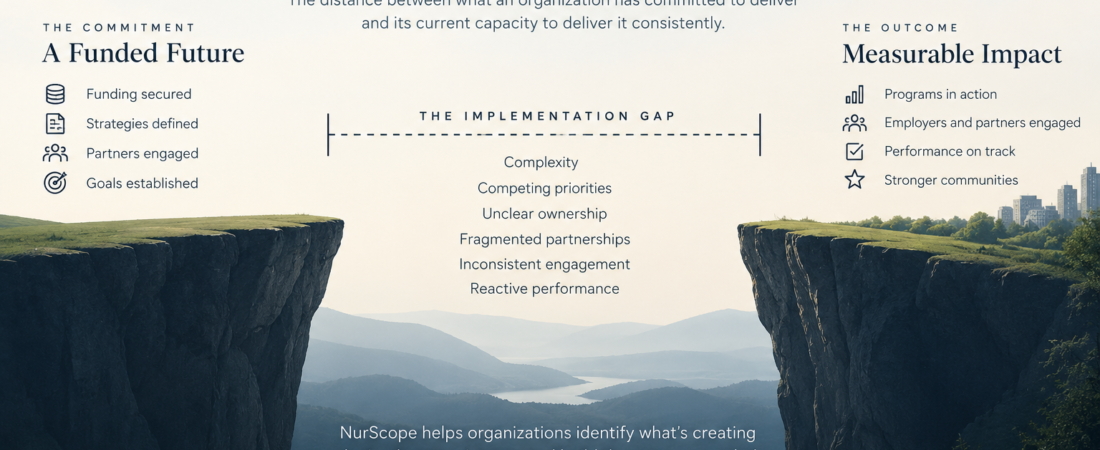
Funding can create the opportunity for change. It doesn’t automatically create the capacity to deliver it.
For mission-driven organizations, receiving funding can feel like the moment an initiative becomes real. A workforce board receives funding to expand training. A community college launches a new workforce program. A city begins an economic-development initiative. A foundation brings multiple organizations together around a shared outcome.
The strategy has been approved. Partners have committed. Goals have been established. Now comes the harder part: implementation.
Between the commitments an organization has made and its ability to consistently deliver on them lies what we call the implementation gap.
Funding Changes the Work
New funding rarely arrives in an empty organization. It enters an operating environment where people already have responsibilities, departments already have priorities, partners already have expectations, and existing systems were often designed around yesterday’s workload.
Then the new initiative adds more: new deliverables, new partnerships, new reporting requirements, new timelines, new stakeholders, and new performance expectations. Sometimes new staff and technology follow. Sometimes they don’t.
The result is a simple but important organizational challenge: the complexity of implementation can increase faster than the systems responsible for supporting it.
This isn’t merely theoretical. The U.S. Government Accountability Office has repeatedly identified capacity, coordination, oversight, transparency, and administrative burden among the challenges associated with federal grants. GAO has specifically noted that limited recipient capacity can adversely affect organizations’ ability to successfully manage and implement grant programs.
Those challenges exist within an enormous system. Federal grants to tribal, state, local, and territorial governments totaled approximately $1.2 trillion in fiscal year 2024. The opportunity created by funding is significant. So is the responsibility to implement it well.
Strategy and Implementation Are Different Capabilities
Organizations understandably devote enormous attention to developing strategies and securing resources. They identify needs, build partnerships, set objectives, develop budgets, write proposals, and define intended outcomes.
Those activities answer an essential question: What are we trying to accomplish?
Implementation introduces a different question: How will this organization—and everyone involved with it—consistently make that happen?
That requires a different set of capabilities. Who owns each part of the initiative? How do responsibilities move across departments? What decisions can frontline teams make, and which require leadership? What happens when a partner misses a commitment? How are employers or community stakeholders integrated into delivery? How does leadership know whether implementation is on track? Who sees emerging problems early enough to do something about them?
Those questions may sound operational, but they are also strategic. When those conditions are weak, even a well-designed initiative can struggle to produce its intended results.
What the Implementation Gap Looks Like
The implementation gap isn’t usually one dramatic failure. More often, it appears as a collection of smaller warning signs that accumulate across an initiative.
Everyone Is Involved, but Ownership Is Unclear
Multi-partner initiatives can create an unusual accountability problem: many organizations are responsible for success, while no single person or organization has visibility across the entire implementation system.
Meetings happen, updates are shared, and people are working. But when something falls between organizations or departments, responsibility becomes less obvious. Over time, seemingly small ownership gaps can become delays, duplicated effort, unresolved decisions, or missed commitments.
New Responsibilities Are Layered Onto Existing Workloads
Funding may create a new initiative without eliminating anything teams were already responsible for delivering. Staff begin absorbing new reporting requirements, meetings, partnerships, participant needs, administrative processes, and performance expectations.
Eventually, priorities compete. The issue isn’t necessarily a lack of commitment or effort. The operating environment may simply be asking existing people and systems to support more complexity than they were originally designed to manage.
Partnerships Exist on Paper but Not Operationally
A memorandum of understanding can establish a partnership. It cannot make the partnership work.
Effective implementation requires clarity about responsibilities, communication, decision-making, information sharing, escalation, and accountability. Organizations may strongly agree about the outcome they want while having very different assumptions about how the work required to achieve that outcome will actually happen.
Research on cross-agency and performance partnerships has repeatedly demonstrated the importance of coordination, planning time, partner buy-in, information sharing, and clearly understood responsibilities.
Stakeholder Engagement Becomes Activity Instead of Infrastructure
An organization may hold employer advisory meetings, community listening sessions, partner roundtables, or stakeholder events and still struggle to translate participation into implementation.
The important question isn’t simply, “Are stakeholders engaged?” It is, “How does their engagement influence decisions, program design, delivery, accountability, and improvement?”
When there is no mechanism connecting participation to implementation, engagement can become something organizations document rather than something they use. Attendance and activity may look healthy while the actual influence of stakeholders on implementation remains limited.
Performance Information Arrives Too Late
Many organizations measure performance. Fewer have systems that help teams recognize implementation problems early enough to change course.
By the time a quarterly report reveals missed targets, the conditions that created the problem may have existed for months. A partnership may have been underperforming, referrals may have slowed, employer participation may have declined, or an internal workflow may have been creating bottlenecks long before the final numbers revealed the effect.
Performance management shouldn’t only explain what happened. It should help organizations decide what to do next.
The Implementation Gap Is Not Evidence of Organizational Failure
This distinction matters. An implementation gap does not necessarily mean an organization has a bad strategy, weak leadership, or incapable staff. Sometimes the opposite is true: ambitious organizations take on ambitious initiatives.
But new commitments can exceed the capacity of the systems originally built to support them. A ten-person collaboration may require informal coordination. A twenty-organization regional initiative may require something considerably more structured.
Similarly, a small workforce program may be managed through existing departmental processes. A new initiative involving education providers, employers, community organizations, government agencies, data systems, and performance requirements may require an entirely different implementation infrastructure.
The question therefore shouldn’t be, “What’s wrong with our organization?”
A more useful question is: “What does this initiative now require from our organization that our current systems weren’t designed to provide?”
That question changes the conversation. Instead of assigning blame, it creates an opportunity to examine whether organizational systems have kept pace with organizational ambition.
Closing the Gap Starts With Visibility
Organizations cannot strengthen implementation conditions they cannot see. Before launching another planning process, adding another meeting, purchasing another platform, or restructuring responsibilities, leaders need to understand where implementation is actually vulnerable.
That means examining the system. Are responsibilities clear? Are workflows supporting the initiative or slowing it down? Do partners understand what is expected of them? Are employers and stakeholders meaningfully integrated? Can teams identify performance problems early? Do leaders have visibility across the initiative? Does the organization have sufficient capacity to sustain delivery?
The answers will rarely be uniformly positive or negative.
An organization may have excellent leadership alignment but fragmented partner workflows. It may have strong employer relationships but weak mechanisms for converting employer input into program decisions. It may have sophisticated performance reporting but unclear accountability for acting on what the data reveals.
That’s why implementation readiness is better understood as a system of interconnected conditions than as a simple measure of whether an organization is “ready” or “not ready.”
From Funded Commitment to Measurable Progress
Securing funding is an accomplishment. Developing a strategy is essential. Building partnerships matters. But those things establish the conditions for an initiative to begin—not a guarantee that it will succeed.
The work between commitment and outcome is implementation.
Organizations that take implementation capacity seriously ask different questions early. They look beyond whether the strategy makes sense and examine whether the operating system surrounding it can support what the strategy demands.
They clarify ownership, build workable processes, strengthen partnerships, create meaningful engagement structures, establish performance visibility, and develop the capacity to adapt when implementation inevitably encounters reality.
Because ultimately, the measure of a funded initiative isn’t the ambition of the proposal. It’s what the organization is able to deliver.
Where Is Your Implementation Gap?
NurScope’s free Implementation Readiness Diagnostic helps organizations take an initial look at the conditions supporting—or potentially constraining—their ability to deliver a funded initiative.
Take the Free Implementation Readiness Diagnostic →